




Key Takeaways
1. What is “When should businesses include 7 placement of pads for AED in safety training,” and why does it matter?
Businesses should include 7 placement of pads for AED scenarios when training staff for workplace cardiac emergencies, especially in offices, factories, retail spaces, events, and Malaysian business premises where fast response can protect lives.
2. How does placement of pads for AED work in a fast emergency answer?
Placement of pads for AED usually means placing one pad on the upper right chest and another on the lower left side of the chest, allowing the AED to analyse the heart rhythm and guide shock delivery.
3. What should businesses do next?
Businesses should combine AED access, CPR awareness, staff drills, and pad placement practice into regular safety training so employees can respond confidently before professional emergency help arrives.
Placement of pads for AED is a practical safety skill every business should include in workplace emergency training, especially when staff may be the first people near a person experiencing sudden cardiac arrest.
In Malaysian offices, factories, retail outlets, event venues, co-working spaces, schools, clinics, and public-facing business locations, having an AED available is only useful when people know how to apply the pads correctly and act quickly.
For businesses, this topic is not only about medical knowledge. It is also about operational readiness, staff confidence, customer safety, and brand trust.
A company that trains its team on AED pad placement shows that it takes workplace safety seriously, not just as a compliance activity but as part of responsible business culture.
The 7 scenarios in this article help businesses understand when AED pad placement should be included in training: adult emergencies, child emergencies, wet chest situations, hairy chest situations, pacemakers, medication patches, and realistic workplace drills.
These scenarios are important because emergencies rarely happen in perfect conditions.
For Malaysian entrepreneurs, SMEs, digital marketers, and content-led businesses, safety education can also become part of meaningful brand credibility.
When companies publish useful health and safety content, they build trust with employees, customers, and collaborators.
Why Should Businesses Teach Placement of Pads for AED in Safety Training?
Businesses should teach AED pad placement because staff may need to support sudden cardiac arrest response before medical professionals arrive at the workplace.
Sudden cardiac arrest is time-sensitive. In a business environment, the first people near the victim are usually not doctors, nurses, or paramedics. They may be reception staff, security personnel, colleagues, managers, teachers, event crew, or front-desk employees.
That is why AED training should not stop at “where the AED is located.” Staff should also understand how to expose the chest, follow AED voice prompts, apply pads correctly, and avoid unsafe placement mistakes.
The American Heart Association explains that early CPR and AED use can significantly improve survival chances in cardiac arrest situations, which makes workplace readiness more than a compliance activity. It becomes a real emergency response responsibility.
Why AED Pad Placement Is a Business Safety Responsibility
AED pad placement is a business safety responsibility because wrong placement can delay rhythm analysis, shock delivery, and effective emergency response.
For Malaysian businesses, safety training is part of workplace professionalism. Offices, factories, retail spaces, event venues, educational centres, gyms, and co-working spaces all welcome people with different age groups, health backgrounds, and emergency risks.
A company does not need to turn employees into medical experts. However, it should make sure selected staff know the basic AED sequence:
- Check safety.
- Call emergency help.
- Start CPR if trained.
- Turn on the AED.
- Expose the chest.
- Apply pads correctly.
- Follow AED prompts.
- Stand clear during analysis and shock.
This kind of training helps reduce panic when an actual emergency happens.
How AED Training Supports Workplace Emergency Readiness
AED training supports emergency readiness by giving staff repeated practice with device prompts, pad diagrams, CPR flow, and safe shock procedures.
Most AEDs are designed for public use. They usually provide voice instructions, visual pad diagrams, and step-by-step prompts. However, during a real emergency, fear and confusion can slow people down.
Training helps staff become familiar with the process before the emergency happens.
Placement of Pads for AED as Part of CPR and First Aid Response
Placement of pads for AED should be taught together with CPR because both actions support faster assessment and possible shock delivery.
AED use is not a separate skill that should be isolated from emergency response. It should be part of a full workplace response flow that includes checking responsiveness, calling emergency services, starting CPR, and assigning someone to retrieve the AED.
A practical training session should show staff how AED pads are applied to bare skin and why clothing, sweat, excessive hair, or wrong positioning may affect the process.
Why Non-Medical Staff Must Understand AED Pad Positioning
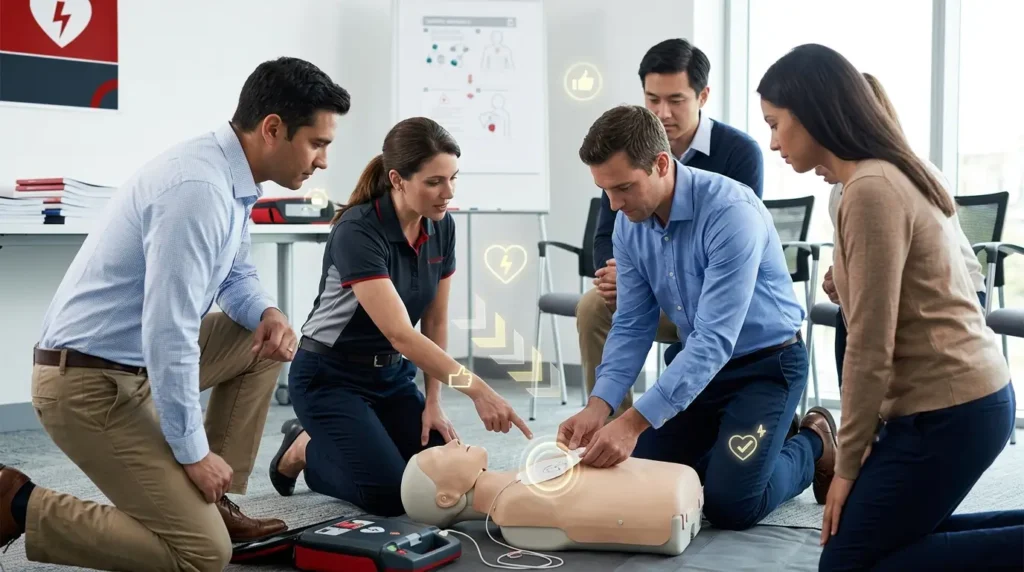
Non-medical staff must understand AED pad positioning because they are often the closest responders during the first critical minutes of collapse.
In business premises, the person holding the AED may be a colleague, admin assistant, security guard, supervisor, shop assistant, trainer, or event coordinator. These people may not have medical training, but they can still follow AED instructions.
The goal is not to diagnose the patient. The goal is to apply the pads properly so the AED can analyse the heart rhythm and guide the next action.
What Is the Correct Placement of Pads for AED on Adults?
The correct adult AED pad position is commonly one pad on the upper right chest and the other on the lower left side.
Standard AED pad placement is usually called the anterior-lateral position. The first pad is placed on the upper right side of the chest, below the collarbone. The second pad is placed on the lower left side of the chest, near the side of the body below the armpit.
Several AED instructions and emergency response guides describe this general adult placement pattern because it helps the shock pathway pass through the heart.
Standard Adult AED Pad Placement on the Chest
Standard adult AED pad placement helps the AED read the heart rhythm and deliver shock energy through the chest effectively.
Businesses should train staff to look at the pad diagram on the AED pads. Different brands may show slightly different visuals, but the general adult placement is similar.
The important point is consistency. Staff should not guess the pad position based on memory only. They should follow the AED diagram, expose the chest properly, and press the pads firmly to the skin.
Upper Right Chest Pad Position
The upper right chest pad is usually placed below the right collarbone and above the right side of the chest.
This position helps create a path across the chest when paired with the lower left pad. During training, staff should practise identifying this area quickly and respectfully, especially when dealing with different body sizes and clothing types.
Lower Left Chest or Side Pad Position
The lower left pad is usually placed on the left side of the chest, below the armpit area.
This pad should not be placed too close to the first pad. If pads touch each other or are too close, the AED may not work as intended. Staff should be trained to keep enough distance between pads and to follow the diagram on the pads.
Why Pads Must Create a Clear Path Through the Heart
AED pads must create a clear electrical pathway so the AED can analyse rhythm and, when advised, deliver a shock across the heart.
This is why correct placement matters. The AED is not simply “sending electricity anywhere.” It needs the pads to be positioned in a way that supports effective analysis and shock delivery.
Avoiding Pad Contact, Loose Adhesion, and Wrong Chest Position
Staff should avoid placing pads over clothing, allowing pads to touch, or applying pads loosely to wet, hairy, or obstructed skin.
When Should Businesses Include the 7 Placement of Pads for AED Scenarios in Training?
Businesses should include seven AED pad placement scenarios when training staff for realistic workplace cardiac arrest situations and practical emergency response confidence.
A strong safety session should include more than the ideal adult case. Real emergencies may involve children, sweat, rain, medication patches, pacemakers, body hair, or limited space.
Training should prepare staff for common complications without overwhelming them.
Scenario 1: Standard Adult AED Pad Placement
Standard adult AED pad placement should be the first scenario because it is the most common AED training foundation.
This scenario teaches staff the basic upper right chest and lower left chest placement. It should include exposing the chest, removing barriers, applying pads firmly, and following AED prompts.
Scenario 2: AED Pad Placement for Children
Child AED pad placement should be included because paediatric emergencies may require child pads or alternative pad positions.
Some AED programs advise using child pads or paediatric settings when available. If pads are too large and may touch, training should explain that one pad may need to go on the front of the chest and the other on the back, depending on AED instructions and training guidance.
Scenario 3: AED Pad Placement When Pads May Touch
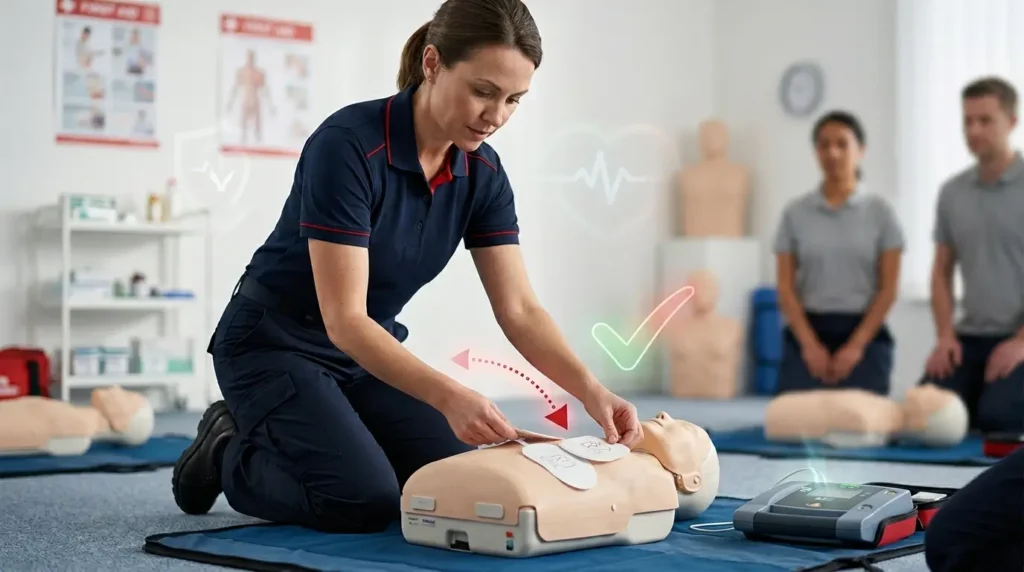
Pad-touching scenarios should be included because close pad contact can interfere with proper AED function during emergency use.
This is especially relevant for smaller bodies. Staff should be trained to follow the AED diagram and use the front-and-back placement option when recommended by the device instructions or training provider.
Scenario 4: AED Pad Placement on Wet or Sweaty Chest
Wet or sweaty chest scenarios should be included because pads need proper skin contact to stay attached and function correctly.
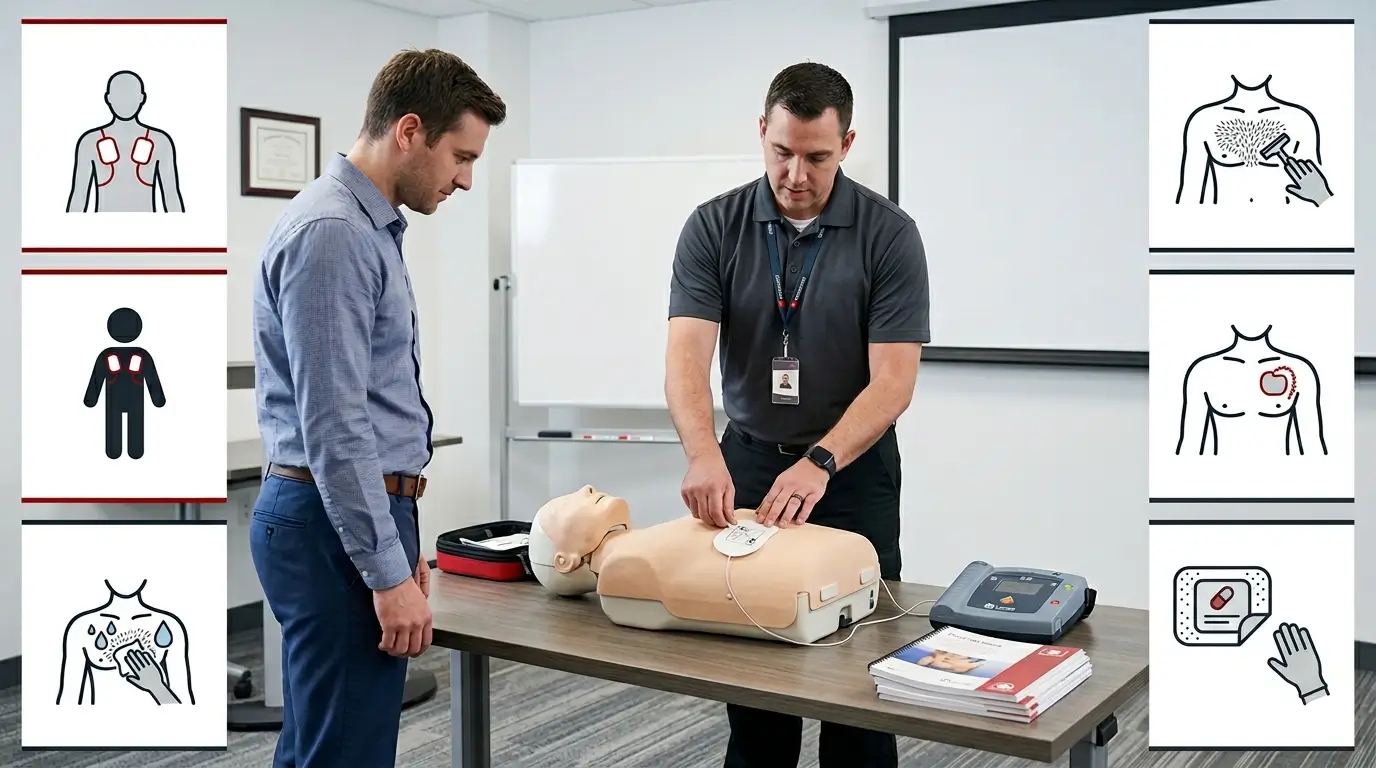
In Malaysia, this is practical for factories, gyms, outdoor events, construction areas, sports venues, and humid workplaces. Staff should learn to dry the chest quickly before applying pads when needed.
Scenario 5: AED Pad Placement Near Pacemakers or Implanted Devices
Pacemaker scenarios should be included because AED pads should not be placed directly over visible implanted medical devices.
A pacemaker or implanted device may appear as a small lump under the skin, usually near the upper chest. Training should teach staff to place the AED pad slightly away from the device while still following AED guidance.
Scenario 6: AED Pad Placement Around Medication Patches or Obstructions
Medication patch scenarios should be included because AED pads should not be placed directly over patches, jewellery, or chest obstructions.
Some emergency guidance advises removing medication patches if they obstruct pad placement and wiping the skin before applying AED pads. This is a useful workplace training point because staff may see patches but not know what to do.
Scenario 7: AED Pad Placement During Workplace Emergency Drills
Workplace drills should include AED pad placement because repeated practice builds staff confidence, speed, and role clarity during emergencies.
A drill can assign roles clearly: one person calls emergency services, one retrieves the AED, one starts CPR if trained, and another controls the surrounding area. This makes the response less chaotic.
How Should Malaysian Businesses Train Staff on Placement of Pads for AED?
Malaysian businesses should train staff using AED trainer units, realistic workplace scenarios, clear role assignments, and refresher sessions.
A practical AED session should be short, repeatable, and scenario-based. Staff should understand not only what to do but also why each step matters.
Training should include:
- AED location awareness.
- Adult pad placement.
- Child pad placement basics.
- Wet chest preparation.
- Pacemaker and patch awareness.
- Pad spacing and adhesion.
- Emergency communication.
- CPR coordination.
Use AED Trainer Units in Workplace Safety Sessions
AED trainer units help staff practise voice prompts, pad placement, and shock-safety commands without using a live defibrillator.
This makes training safer and more realistic. Staff can practise under pressure, repeat common mistakes, and correct them before they ever face a real emergency.
Practise Pad Placement With Realistic Emergency Scenarios
Realistic emergency scenarios help staff apply AED knowledge in the same environment where a cardiac arrest may happen.
A factory team should practise around production areas. A retail team should practise near customer spaces. An event team should practise crowd control and AED retrieval. An office team should practise from reception to meeting rooms.
Office, Factory, Retail, Event, and Co-Working Space Examples
Each workplace should adapt AED pad placement training to its floor layout, staff roles, visitor flow, and emergency access points.
Training Staff to Follow AED Voice and Visual Prompts
Staff should be trained to follow AED voice and visual prompts rather than relying only on memory during high-stress emergencies.
What Common AED Pad Placement Mistakes Should Businesses Prevent?
Businesses should prevent AED pad placement mistakes involving clothing, moisture, body hair, pacemakers, medication patches, poor spacing, and weak pad adhesion.
Mistakes usually happen because staff panic, rush, or have never practised. The solution is not complicated: simple repeated training, visible AED signage, and clear emergency roles.
Placing AED Pads Too Close Together
AED pads placed too close together may reduce effectiveness, especially on smaller bodies where pad spacing becomes more difficult.
This is why staff should be trained to check the pad diagram and use alternative placement when required.
Applying Pads Over Clothing, Moisture, or Hair
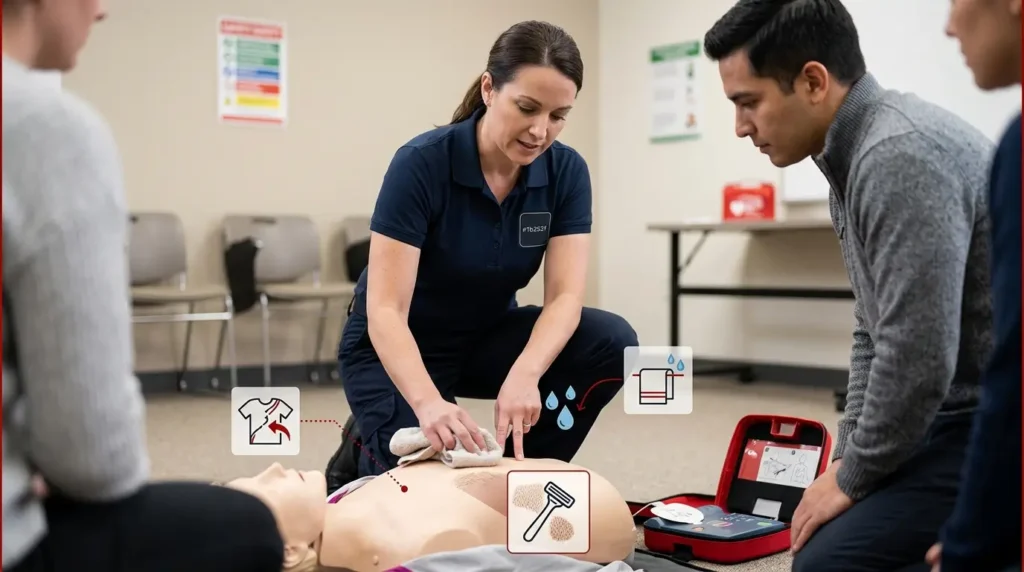
AED pads should be applied to bare skin, not over clothing, heavy moisture, or thick chest hair that prevents adhesion.
Training kits should include a towel and razor if recommended by the AED kit contents. Staff should know that preparation should be fast but practical.
Ignoring Pacemakers, Jewellery, or Medication Patches
Ignoring pacemakers, jewellery, or medication patches can create avoidable complications during AED pad placement and emergency response.
Staff should not waste time trying to understand every medical device. They only need practical awareness: do not place pads directly over obvious obstructions, and follow AED instructions.
Placement of Pads for AED Checklist Before Shock Delivery
A quick placement of pads for AED checklist helps staff confirm bare skin contact, correct spacing, firm adhesion, and safe positioning.
Where Should AEDs Be Located So Staff Can Apply Pads Quickly?
AEDs should be placed in visible, accessible, unlocked, and high-traffic areas where trained staff can reach them quickly.
Pad placement cannot happen if the AED is too far away, locked in a room, hidden behind a counter, or known only to management. AED access should be planned around real movement inside the premises.
Place AEDs in Visible, Accessible, and High-Traffic Areas
Visible AED placement helps staff, visitors, and emergency responders locate the device quickly during a cardiac arrest incident.
Good locations include reception areas, lobbies, security counters, lift areas, event halls, training rooms, sports facilities, and central corridors.
Match AED Location With Staff Response Time
AED location should be matched with response time so staff can retrieve the device and apply pads without unnecessary delay.
Large premises may need more than one AED. For example, a factory floor, warehouse, or event venue may not be well covered by one device at the front office.
Reception Areas, Lobbies, Production Floors, and Event Spaces
AEDs should be positioned near areas with high human traffic, higher physical risk, or longer emergency access time.
Why AED Access Matters Before Pad Placement Can Happen
AED access matters because even well-trained staff cannot apply pads quickly if the device is hidden, locked, or too far away.
How Can AED Pad Placement Improve a Company’s Safety Culture and Brand Trust?
AED pad placement training improves safety culture by showing employees, customers, and partners that the company treats emergency readiness seriously.
For Malaysian businesses, brand trust is not only built through marketing campaigns. It is also built through responsible operations.
A company that invests in safety training communicates care, preparedness, and professionalism.
Workplace Safety as Part of Business Credibility
Workplace safety supports business credibility because customers and employees trust brands that take health, risk, and emergency preparation seriously.
For Socmad.com readers, this is also a content opportunity. Businesses can share safety education through blogs, infographics, internal posters, training recaps, and awareness campaigns.
Why Safety Training Matters for Malaysian Business Reputation
Safety training matters for reputation because responsible companies are expected to protect people, not only promote products or services.
This is especially relevant for businesses with public-facing premises, children’s programmes, events, fitness spaces, clinics, training centres, and hospitality environments.
Connecting Health Preparedness With Responsible Business Content
Health preparedness content can help Malaysian businesses educate audiences while strengthening trust, credibility, and brand authority.
How Should Businesses Build AED Pad Placement Into Their Safety Content Strategy?
Businesses should build AED pad placement into safety content by turning training knowledge into clear, useful, and visually engaging educational material.
A business can use safety content to inform staff, reassure customers, and support brand credibility. This fits Socmad.com’s wider direction of helping Malaysian business content become more useful, visible, and impactful.
Turning AED Training Into Educational Workplace Content
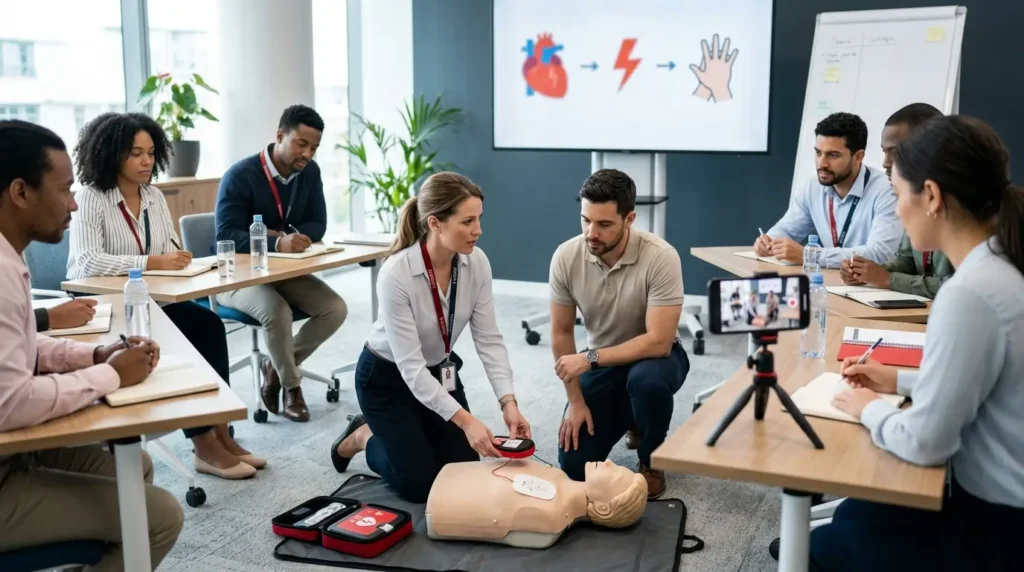
AED training can become educational content when businesses explain practical safety steps in simple, visual, and audience-friendly formats.
Examples include blog posts, safety posters, short videos, internal newsletters, LinkedIn updates, and event safety checklists.
Using Visual Templates, Infographics, and Digital Awareness Campaigns
Visual templates and infographics help simplify AED pad placement concepts for employees, customers, and non-medical audiences.
Tools like Piktochart, Canva, and structured content templates can help businesses present health and safety information clearly. The key is to avoid confusing medical claims and focus on practical awareness, proper training, and credible references.
How Socmad-Style Digital Content Can Make Safety Topics More Engaging
Socmad-style digital content can make AED safety topics more engaging by combining business relevance, visual clarity, and practical workplace education.
Businesses should include AED pad placement in safety training because real emergencies require more than AED ownership.
Staff need to know where the device is, how to expose the chest, how to follow AED prompts, and how to handle practical placement challenges involving children, moisture, body hair, pacemakers, and medication patches.
When companies train clearly, they protect people and strengthen workplace trust.
If your business wants to improve workplace safety awareness, start by reviewing your AED location, staff training routine, and emergency response content.
For deeper guidance on safe and practical AED readiness, read The Importance of Correct AED Pads Placement During Cardiac Arrest and use it as a reference point for training discussions, internal safety content, and staff education.
FAQ
How should AED pads be positioned on adults for effective use?
AED pads should generally be positioned with one pad on the upper right chest below the collarbone and the other on the lower left side of the chest. This placement helps the AED analyse the heart rhythm and guide shock delivery when required. Staff should always follow the visual diagram and voice prompts provided by the AED model being used.
What are the differences in AED pad placement for children versus adults?
Adult AED pad placement usually uses the upper right chest and lower left chest position. For children, businesses should use paediatric pads or the child setting when available. If pads are too large or may touch, some AED instructions may guide users to place one pad on the chest and one on the back. Always follow the AED device instructions.
Common errors in AED pad application
Common AED pad application errors include placing pads over clothing, applying pads on wet skin, positioning pads too close together, ignoring thick chest hair, and placing pads directly over pacemakers or medication patches. Businesses can reduce these mistakes by using AED trainer units, refresher sessions, and scenario-based emergency drills.
AED pad placement considerations for patients with pacemakers
If a patient has a visible pacemaker or implanted device, the AED pad should not be placed directly over the lump. Staff should position the pad slightly away from the device while still following the AED pad diagram. Training should explain this clearly so responders can act quickly without becoming confused during a real emergency.
Are there AED training courses that cover proper pad placement?
Yes, AED, CPR, and first aid training courses commonly include proper AED pad placement, device prompts, safety checks, and emergency response sequence. Businesses should choose training that includes practical hands-on practice, adult and child scenarios, and refresher sessions so staff can respond with confidence.